
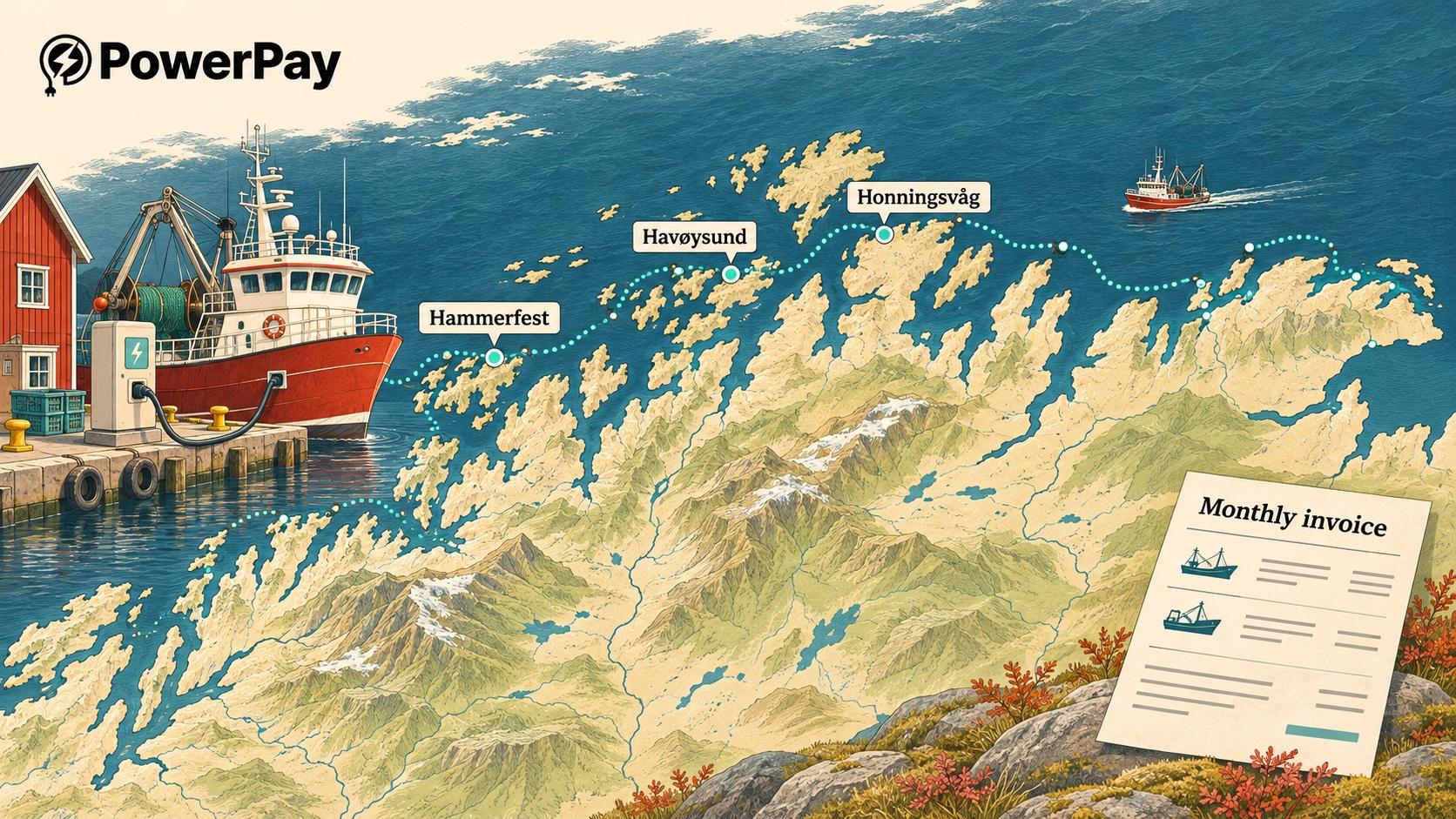
One Shore Power System Along the Finnmark Coast
A fishing vessel sailing from Hammerfest to Havøysund and on to Honningsvåg calls at several ports in a single trip. When those ports use PowerPay, the crew can connect to shore power the same way at every quay. Each port sets its own rates, and the vessel operator can have consumption invoiced without anyone on board needing a company card.
Ports across much of the Finnmark coast use PowerPay, from Alta and Hammerfest in the west to Gamvik and Vardø in the east. The value of that network becomes clear when a vessel arrives at an unfamiliar port after the harbour office has closed. The crew recognises the QR code on the power pedestal, scans it, checks the rate and starts the supply. Before departure, the crew ends the session. PowerPay records the consumption against the customer’s account.
One Monthly Invoice from Each Port
For a vessel operator managing a fleet, even small shore power charges can create a surprising amount of paperwork. If every connection requires a card payment, someone on board needs a company card or has to pay out of pocket. Each receipt then has to reach the accounts team and be matched to the right vessel.
With a business account, the operator can receive an invoice for electricity and water. PowerPay can send invoice line items directly to the port’s chosen invoicing system. Once the integration is in place, the port can consolidate the month’s charges into one invoice, with separate line items for each vessel. The accounts team makes one payment to the port and can see exactly how much of the cost belongs to each vessel.
Harbour staff no longer need to read meters, work out which vessel used an outlet or re-enter consumption figures in the billing system. The crew can focus on departure, and the port can invoice through the system it already uses.
How Måsøy and Hammerfest Use PowerPay
In Måsøy, each shore power outlet has its own QR code. Visitors can pay by card, while commercial customers can arrange invoicing through the harbour office. A visiting leisure boat and a fishing vessel that uses the quay throughout the season can connect to the same outlet and each pay in the way that suits them. Read how Måsøy Næring og Havn uses PowerPay.
In Hammerfest, Harbour Master Sturla Nilsen says customers have welcomed the ability to start and stop their own shore power supply. He also points to the financial impact for the port. It gets paid for the electricity it supplies, and Nilsen reports that its shore power revenue has never been higher since PowerPay was introduced.
In Bodø, the Same Platform Handles Electricity and Water
At selected berths in Bodø, boaters can pay for their berth and shore power by scanning the QR code on the power pedestal. The Port of Bodø also uses PowerPay to meter fresh water supplied to cruise ships and vessels on Norway’s coastal route. PowerPay sends the consumption data directly to Grieg Connect’s PORT harbour management system, so the billing details are ready by the time the vessel leaves the quay. Explore shore power at the Port of Bodø.
Operations Manager Morten Nydal describes a cruise ship that took on 110 cubic metres of fresh water in two hours. By the time the ship was ready to depart, the invoice had already reached the bridge. Read how the Port of Bodø digitised fresh water supply and billing.
Major Marinas in Southern Norway Use the Same System
In Asker, Leangbukten Båtforening upgraded its existing power pedestals with PowerPay Connect. According to CEO Erik Roede, the marina went from reading 1,080 meters manually to automated metering and self-service payment in just two weeks. At a marina with around 1,250 berths, that removes an entire round of manual meter readings from every billing cycle.
At the Municipality of Kristiansand, Morten Nilsen is responsible for 4,200 berths across 24 marinas. He says PowerPay is easy to use and generates few support requests. Solta and Ronsbukta are two of the municipal marinas where boaters use PowerPay to access shore power.
Along the Finnmark coast, every additional port makes the network more useful. A vessel operator can give its crews one set of instructions that works across multiple ports, while each port retains control of its own rates, outlets and customer relationships.
Would you like to connect your port to the network? We can review your existing power pedestals, water points and invoicing system with you, and show how consumption can be tracked from the outlet on the quay to the invoice received by the vessel operator. Contact PowerPay